How to Hang Artwork in Your Home
To display artwork at its best there are a few simple things to keep in mind. Here are a few ideas for you to consider before you begin.
Picture hanging hardware
Typically I use picture hanging hooks to hang artwork on a wall, but sometimes I use just nails, especially with small works on a cradled panel. Using nails to suspend small paintings at the top edge of the cradled panel rather than from a hanging wire will almost eliminate the forward lean you sometimes get when using picture wire with small works.
Keeping it level
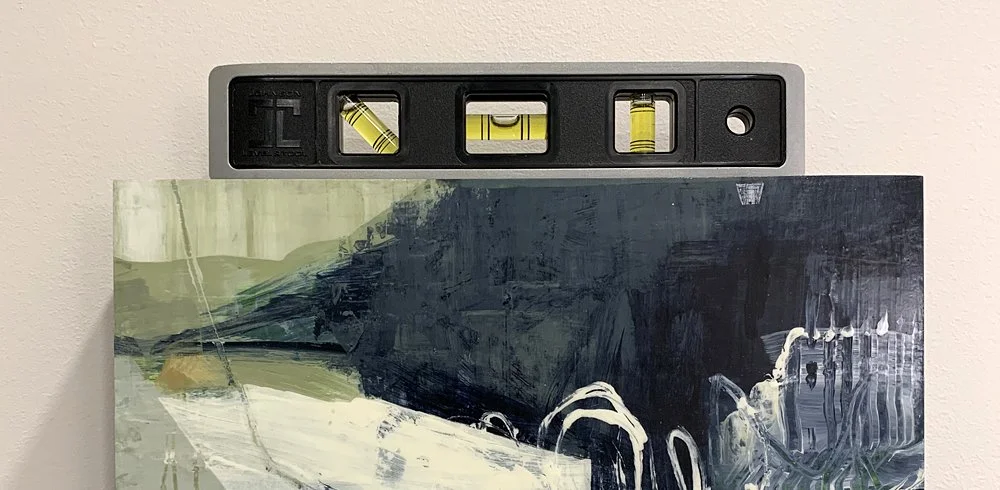
Whether you use nails or picture hooks, I always recommend using two when hanging artwork to help keep your painting level. It requires a bit more measuring and care but is worth the effort to keep your artwork from shifting out of its position on your wall. This is especially important if there is a lot of foot traffic near your painting and it's likely to get brushed or knocked when someone walks by.
Attaching picture bumpers to the bottom two corners will also help to keep your artwork in place. An added benefit is that picture bumpers will help a leaning picture lay more flush against the wall. I attach picture bumpers to all of my panels as part of my finishing process.
How high to hang artwork
Artwork is best appreciated at eye level. This means that the centre of the artwork should be about 57” (145 cm) from the floor.
For those who are used to hanging artwork too high this will seem low but it isn’t. It works for most people and most home environments. Of course there are times when this doesn't work, for example when hanging art above a fireplace mantel, but generally speaking 57” is the right height.
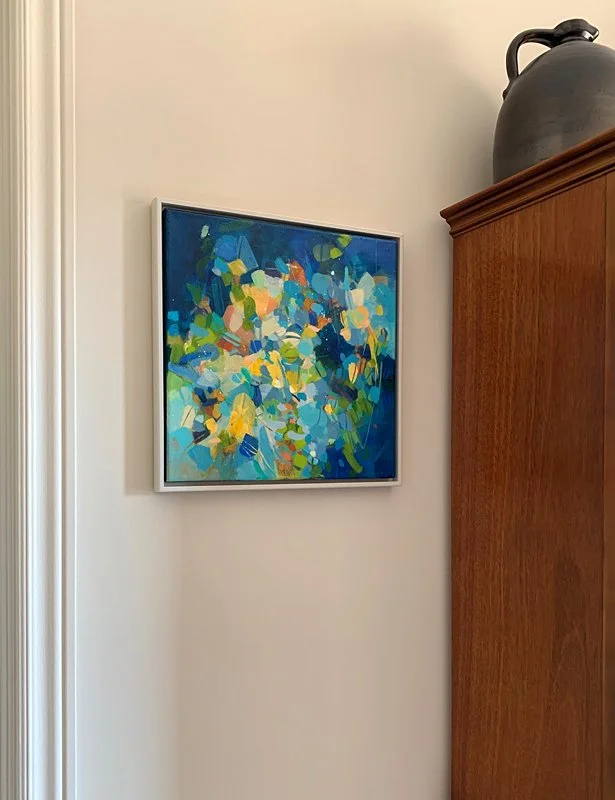
Moon Garden 4

Moon Garden 2 and 3
Hanging two or more artworks together
When displaying two or more paintings together, treat the whole group as the artwork. This means that the centre of the grouping is 57” above the floor. This way each artwork can be viewed at a comfortable height.
How far apart should each piece in a group be?
When hanging a group of artwork, the goal is to have each piece of artwork have enough space around it so that it can be appreciated on its own and not feel as if it is crowded by its neighbours.

On the other hand, the individual artworks need to be close enough to the others in the grouping so that they all feel as if they belong to a cohesive whole.
A distance between artworks of as little as 1” or as much as 12” or more might be appropriate depending on the scale of the artwork being displayed, how many are in the grouping and the size and proportion of the room and furnishings. As a loose guideline begin with 4”-5” between works both vertically and horizontally and decide if it suits the grouping and the surroundings.
The key consideration is whether the distance feels correct in the context of the room.
Also, consider the type of display you want to create. Do you have a series of collage works that are all framed using the same colour and material and are framed to the same size? A formal grid layout, with each piece separated by the same distance both vertically and horizontally, is a very elegant way to display this type of grouping.
Do you have paintings and drawings of differing sizes to display together? An informal grouping with a looser approach to the spaces between can be a pleasing way to present an eclectic collection of art.
In some ways this is an easier way to tackle the task of hanging artwork, as getting the measurements between pieces just right is not as important. Remember the key is to group them close enough that they present as a group but far enough apart so that each can be appreciated on its own.
Oftentimes it comes down to what feels right for the collection and the room in which it’s displayed. It’s a similar process to making art and knowing when it’s finished and a pleasing balance has been achieved. (I’ve written more about this sense of “just” as part of the painting process in this blog post.)
Creating vignettes with art
A charming way to display artwork in your home is to include a work as part of a grouping of other decorative items. Just like when grouping artwork together on a wall, the elements that are part of the vignette should read as a cohesive whole and relate to one another. This means that your artwork will likely be seen at a height other than 57”.
As an example, a small watercolour that is part of a vignette over a desk where there is also a lamp and a stack of books and a pretty vase, is hung in relation to the other items in the vignette. This way the artwork can be enjoyed as part of the whole visual display, rather than floating above it.
Just like when hanging a grouping of art, the spacing between the art and the other items in a vignette is a bit of a judgement call. Keep in mind that the art and the other objects in the grouping should read as a cohesive whole and this will help to determine the height at which to hang your artwork.
Arranging and hanging artwork in your space can be a fun and creative project. By following these simple guidelines, your collection of artwork will surely be displayed at its best.
Add some colour to your inbox.The Studio Journal
A THOUGHTFULLY CRAFTED COLLECTION of STUDIO NEWS, CREATIVE INSIGHTS and INTERESTING TIDBITS JUST for FUN!