Staccato Lines, Sinuous Lines and Flat Areas of Colour
Most of my paint brushes languish, unused and unloved in a brown Folgers Coffee tin next to the sink in my studio.
Sure there are a few favourites in there that get used regularly, some stiff or fraying, the handles covered in daubes of paint. But then there are the others, that never seem to get a turn to make their mark.
I’m not really a fan of painting with brushes. I don’t usually like seeing brush marks in my work so even when I use a paint brush to apply paint I often go right over it with a rag or the blunt end of the brush to disguise the mark.
An unconventional mark making tool
On the other hand I do like to apply paint and move it around the painting surface with unconventional tools.
A paint brush, or even a palette knife just can’t make the kinds of marks that these tools can make.

The first one that I reach for, most every day of my practice, is a kitchen spatula (some call it a scraper) that’s missing its handle.
It has just the right amount of flex in it for me: Not too rigid and not too pliable.
It allows me to apply paint thickly or thinly as the mood strikes.
My repurposed spatula doubles as a means to remove excess paint and then to swipe it onto another area of the work surface.
A variety of marks and lines
Different paint effects can be created by applying varying amounts of pressure with the spatula.

Light pressure applied at a 45 degree angle over thick wet paint creates an area of flat, smooth colour.
Heavier pressure on wet paint applied to a textured surface will push the wet paint down into the recesses, while at the same time removing it from the raised sections.
Dragging the narrow edge of the tool through wet paint, I can make a variety of marks from short staccato repeating lines to long and sinuous lines of undulating widths.
Sometimes I paint the edge of the spatula and then quickly apply that to the painting surface for thin lines of colour.
Collage elements
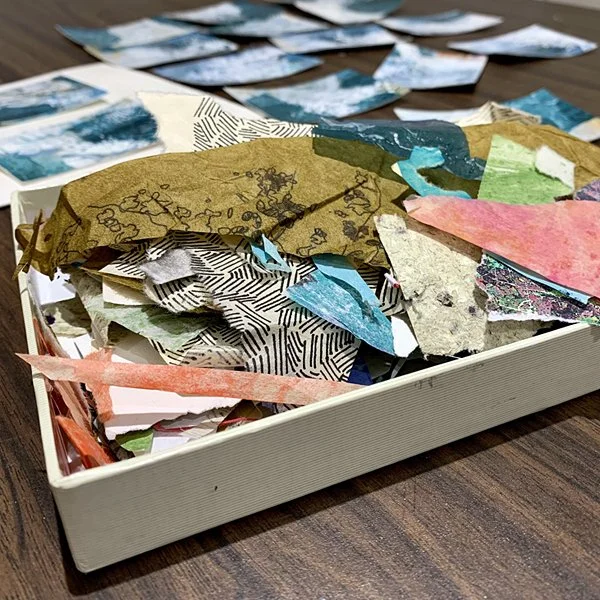
When adding collage paper elements in my work, I want good, bubble free adhesion of the papers to the painting.
Nothing works better than my repurposed spatula for this task. Pushing the glued paper onto the the surface with this tool ensures good attachment while at the same time works out any air bubbles from underneath.
My trusty repurposed kitchen tool
There are similar purpose-made art tools on the market, and I’ve tried a few. But nothing fits my hand and habit as well as my trusty broken kitchen spatula.
Add some colour to your inbox.The Studio Journal
A THOUGHTFULLY CRAFTED COLLECTION of STUDIO NEWS, CREATIVE INSIGHTS and INTERESTING TIDBITS JUST for FUN!